

What waterproofing does after the tile goes on
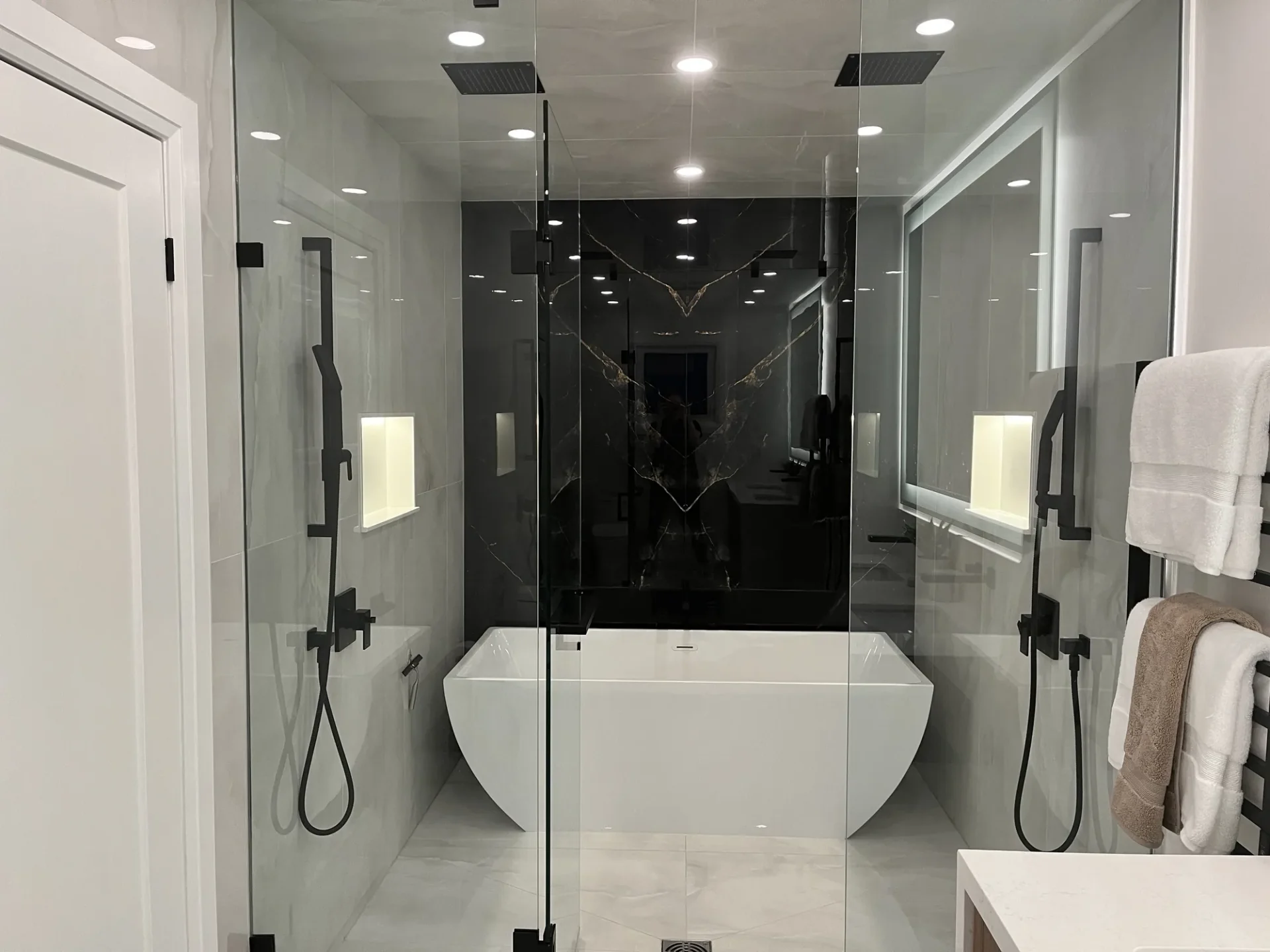
Tile is the surface you choose. Waterproofing is the layer that decides whether the ceiling below the bathroom is still intact in ten years. Once the tile is set, the membrane disappears permanently. That is why the work has to be done correctly the first time and why it is never the place to save a few hundred dollars.
What the membrane actually does
A modern bonded waterproofing system is a continuous layer applied over the shower walls and floor (and often the entire bathroom floor) before any tile is installed. It turns the substrate into a watertight shell. Water that gets through the grout or around a fitting is held inside the shell and directed to the drain instead of into the framing, the subfloor or the room below.
The critical details are the transitions: where the floor meets the wall, where the membrane turns into the niche, where it seals around the drain, the mixing valve and any penetrations. These junctions are where most failures begin. A membrane that is discontinuous at any of those points is not a waterproofing system; it is a partial coating.
What the tile does not do
Grout is not waterproof. Neither is the tile itself when water can travel behind it through incomplete coverage or through movement joints. Relying on the surface finish to keep water out is the old method, and it is the reason so many bathrooms of a certain age have damaged ceilings underneath. The membrane is what makes the modern assembly reliable.
Where the height and the slope come in
The membrane follows the slope of the shower floor. That slope has to be formed in the substrate before the membrane goes on; it cannot be created with tile adhesive afterwards. The same is true for the curb or the linear drain detail. These elements are set at the waterproofing stage, not at the tiling stage. Changing them later means opening the finished shower.
Why it appears as its own line
Waterproofing is itemised because it is a distinct trade activity with its own materials, time and inspection point. Folding it into a general “tile” number hides both the cost and the importance. When you see it listed separately you can ask exactly what system is being used, how the transitions are detailed, and who checks them before the tile goes on. Those are the questions that matter.
What to ask at the measure
- Which waterproofing system will be used, and is it a bonded membrane over the entire wet area?
- How are the corners, the niche, the drain and the valve penetration detailed?
- Is the bathroom floor outside the shower also waterproofed, or only the shower itself?
The membrane is the part of the bathroom you will never see again and the part that protects everything you will see. It is worth getting right while it is still accessible.