

Gas Fireplace vs Electric Fireplace for a GTA Home
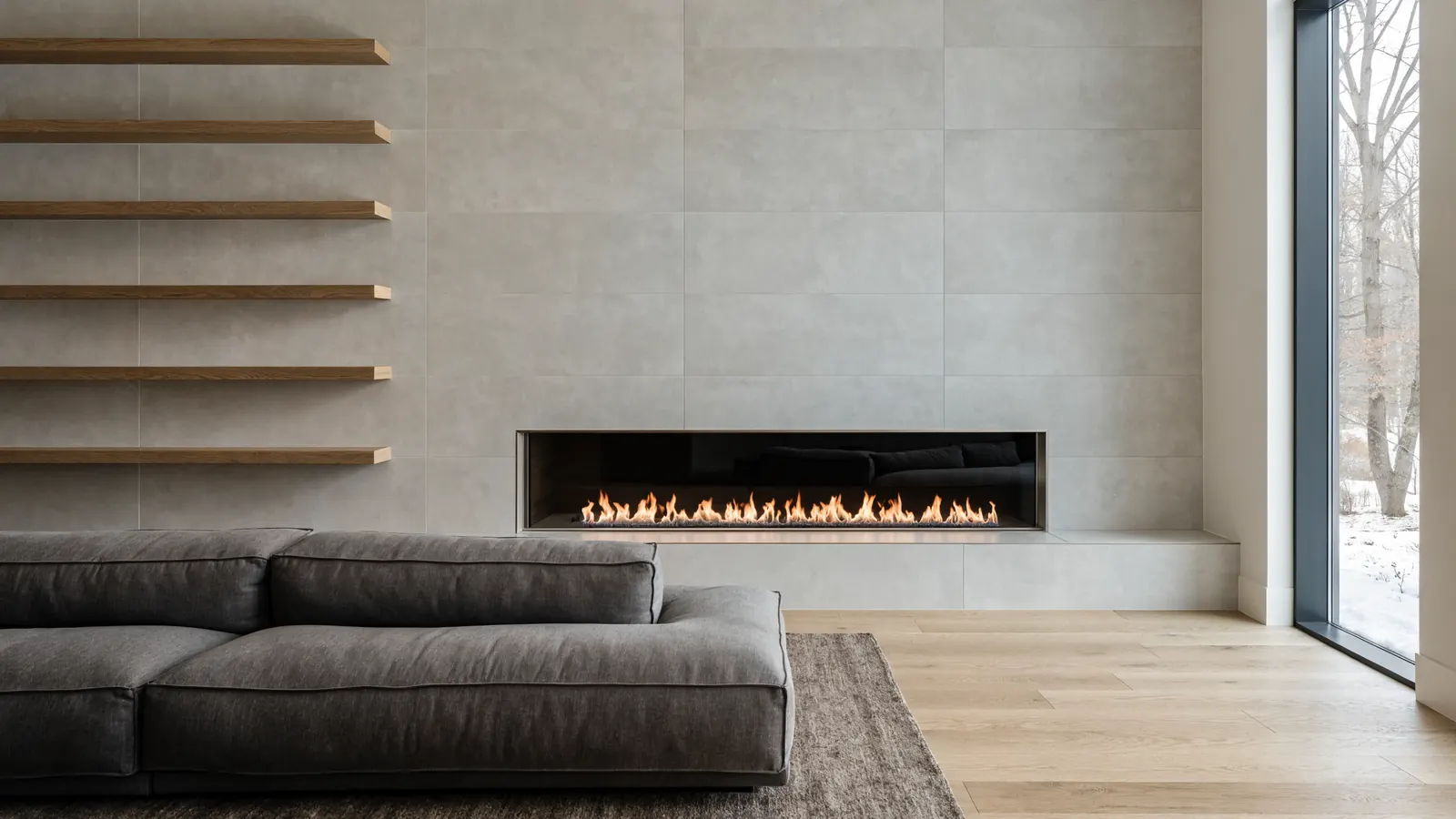
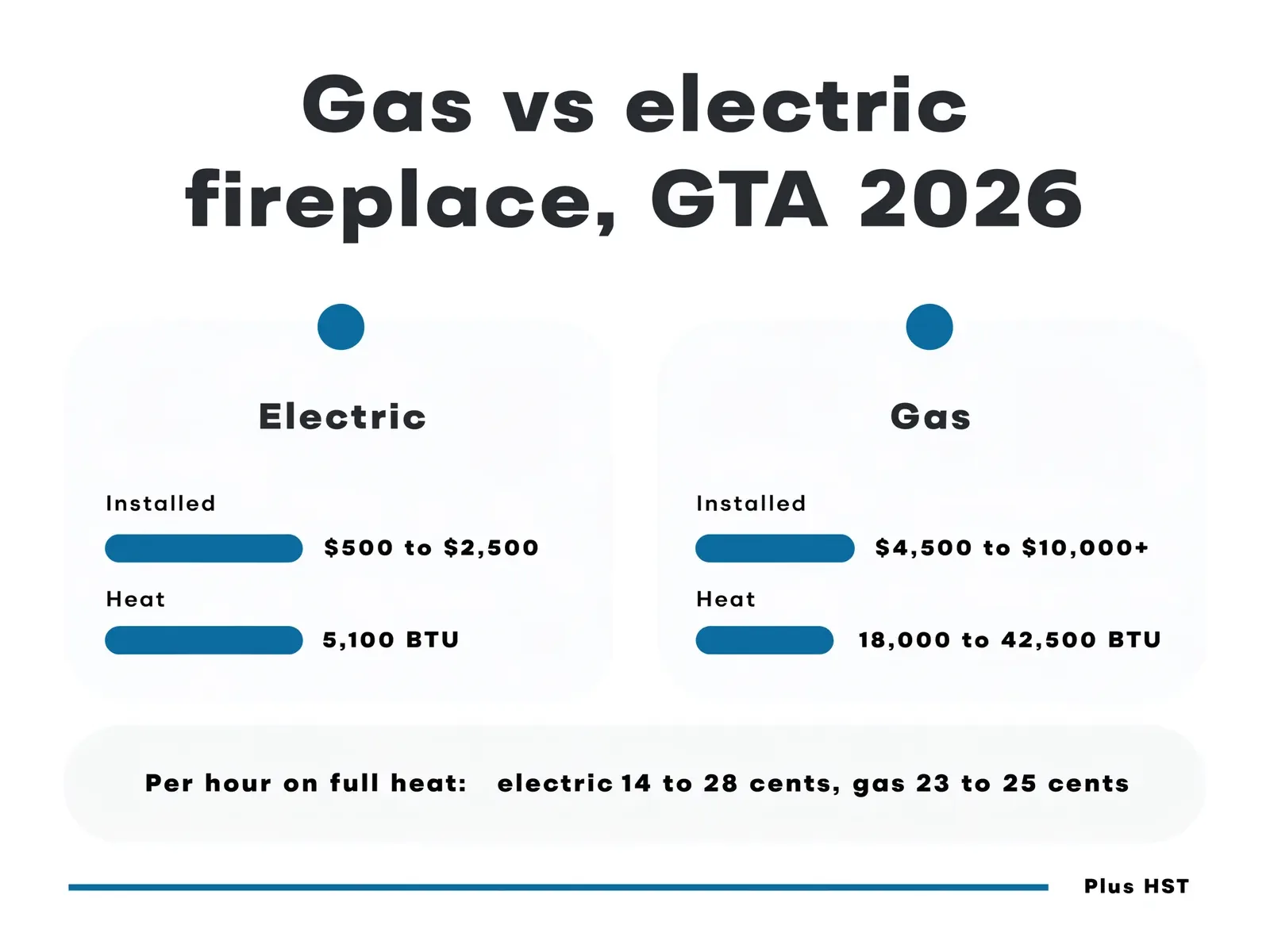
Gas fireplace vs electric fireplace, GTA 2026: gas gives real heat to a family room on an exterior wall. It costs about $4,500 to $10,000 or more installed. Electric is flexible and costs about $500 to $2,500, plus HST on both, though its heat costs far more per BTU.
Quick numbers
| What you are comparing | Gas fireplace | Electric fireplace |
|---|---|---|
| Installed cost | $4,500 to $10,000 or more, new direct ventSource: Toronto Comfort Zone | $500 to $2,500Source: Toronto’s Fireplace Store |
| Running cost per hour, full heat | About 23 to 25 centsSource: OEB, Enbridge rates July 2026 | About 14 to 28 centsSource: OEB, rates from Nov 1, 2026 |
| Heat output | About 18,000 to 42,500 BTU | About 5,100 BTU from a 1,500 watt heater |
| Venting | Direct vent through a wall or roof | None |
| Permit or inspection | Usually a permit, plus gas inspection | ESA permit for new wiring |
| Typical time on site | 1 to 2 weeks | 1 to 2 weeks |
Install prices are ranges published by GTA fireplace sellers and installers in 2026, linked so you can check them. Running costs are our arithmetic from Ontario Energy Board rates, before HST and delivery fees. Gas heat output is the range across one Toronto retailer’s 2026 lineup.
The weeks on site are our own schedules for a new insert with a feature wall.
This guide is written by Alex Portnik, our Master Electrician, who files the ESA permits on every fireplace wall we build. Most questions about this choice end up at the electrical panel or the vent route. That is where this guide spends its time.
The short answer: gas fireplace vs electric fireplace
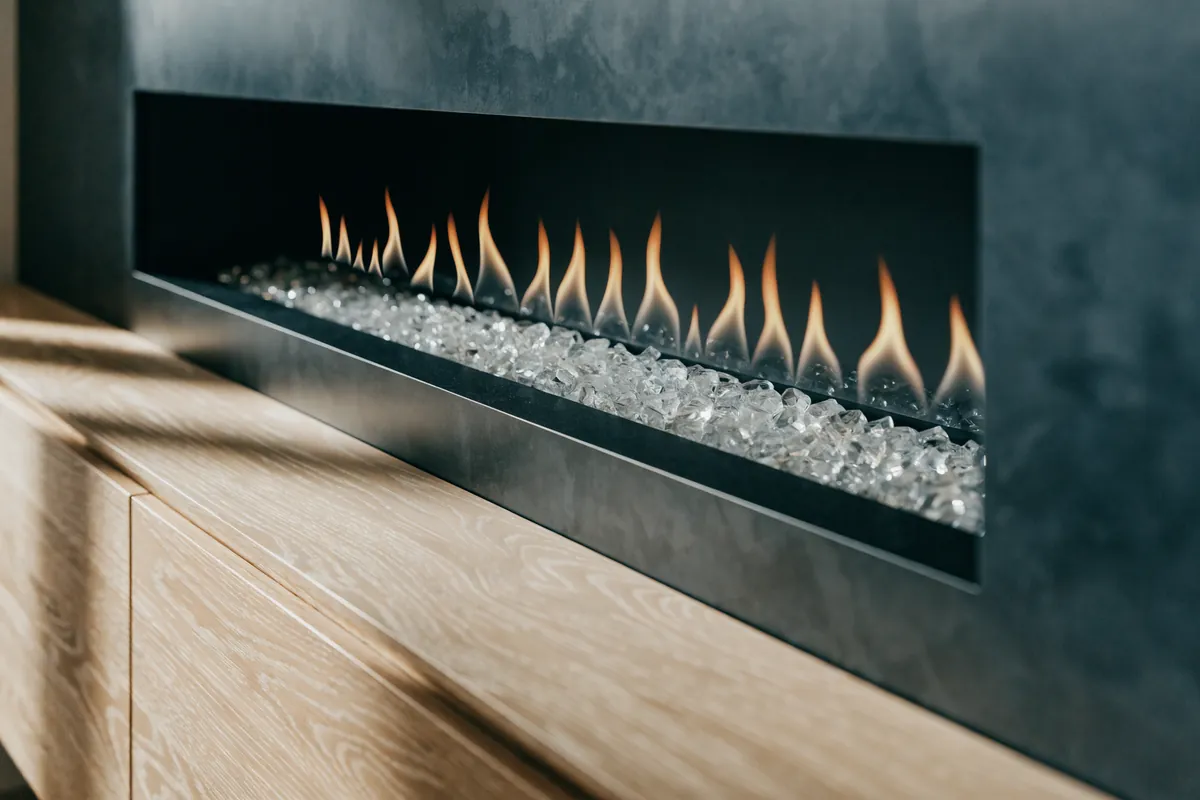
Gas is a heating appliance with a real flame. It suits a family room you use every winter evening, on an exterior wall where the vent can run straight out.
Electric is a 1,500 watt heater behind a flame effect. It suits a living room, basement, bedroom or condo where you mostly want the look, with some warmth on cold nights.
If the fireplace has to heat the room, buy gas. If it mainly has to look good on a media wall, buy electric and put the savings into the finish.
There is a third option, and we have built it into Vaughan feature walls. A water-vapour fireplace makes a flame from fine mist and light. It gives no real heat, needs a water line but no vent, and the front stays cool.
Install cost compared
The fireplace unit is only part of the quote. With gas, the natural gas line, the vent and the permit add up fast. With electric, the main extras are framing and a proper circuit.
These are the electric figures reported for Canadian installs in 2026, unit extra unless noted.
| Electric install | Reported cost | What it includes |
|---|---|---|
| Wall-mounted or plug-in unit, installed | $500 to $2,500Source: Toronto’s Fireplace Store | Unit and mounting, freestanding to built-in |
| Recessed into an existing wall | $700 to $2,500Source: Electric Fireplaces Canada | Framing, drywall cut and patch, electrical |
| Built-in fireplace in a new bump-out | $1,000 to $3,500 or moreSource: Electric Fireplaces Canada | Framing, hardwiring or outlet, drywall, trim |
Gas is quoted as four parts: the unit, the vent, the gas line and the wall around it. Here is how one Toronto installer breaks it down for 2026.
| Gas install item | Reported cost | What moves it |
|---|---|---|
| Gas insert in an existing wood fireplace | $3,000 to $6,500 installedSource: Toronto Comfort Zone | Condition of the chimney and liner |
| Gas line run | $500 to $1,500Source: Toronto Comfort Zone | Distance from the meter, spare capacity |
| Venting | $500 to $2,000Source: Toronto Comfort Zone | Straight out a wall is cheapest, a roof run costs more |
| Framing and finishing | $1,000 to $5,000 or moreSource: Toronto Comfort Zone | Drywall at the low end, full stone at the top |
| New direct-vent gas fireplace, all in | $4,500 to $10,000 or moreSource: Toronto Comfort Zone | Unit size, vent route, finish |
Both tables are in Canadian dollars, plus HST. A full feature wall in slab or stone is a separate budget. Our fireplace feature wall cost guide prices it by finish and square foot.
Our own quotes list the insert, the wall, the gas or electrical work and the finish on separate lines. You can see which part is carrying the weight before you sign.
Running cost and heat output
Per hour, the operating cost of the two is about the same at Ontario rates. The difference is how much heat each one puts into the room for that money.
| Setting | Cost per hour | Heat into the room |
|---|---|---|
| Electric, flame effect only | Pennies for a whole eveningSource: Toronto Comfort Zone | Almost none |
| Electric heater, 1,500 W, ultra-low overnight | About 6 centsSource: OEB, 3.7 cents per kWh | About 5,100 BTU |
| Electric heater, 1,500 W, off-peak | About 14 centsSource: OEB, 9.1 cents per kWh | About 5,100 BTU |
| Electric heater, 1,500 W, on-peak | About 28 centsSource: OEB, 18.9 cents per kWh | About 5,100 BTU |
| Gas fireplace, 30,000 BTU, on full | About 23 to 25 centsSource: OEB, Enbridge rates July 2026 | Several times more |
How we got there: a 1,500 watt heater uses 1.5 kWh an hour at the new OEB prices from November 1, 2026. A 30,000 BTU gas fireplace burns about 0.85 cubic metres an hour. Enbridge supply, transportation and delivery add up to roughly 27 to 29 cents a cubic metre.
Fixed monthly charges, delivery fees and HST are left out of both. Most Vaughan homes already pay the gas customer charge for the furnace, so adding a fireplace does not add that line.
One Toronto retailer puts gas heat at roughly three to six times cheaper per BTU at 2026 Ontario rates (Toronto Comfort Zone). That matches our arithmetic. Electric wins only when you run the flame without the heater, which many people do most of the year.
What 5,100 BTU means in a real room
A 1,500 watt electric heater is a space heater with a nicer face. It is good supplemental heat, or zone heating, for one room, so the furnace can sit a degree or two lower.
It will not carry an open-concept main floor in January. In a family room with a cathedral ceiling and a wall of glass, you will barely notice it.
A gas fireplace on full can keep that same room warm, and many models run during a power outage. That matters in the GTA, where winter ice storms can knock out power for a day or more.
Venting, gas lines and permits
An electric fireplace needs a wall and a circuit. A gas fireplace also needs a fuel supply, a way to get exhaust outside and a licensed gas fitter.
Direct vent, B-vent and ventless
Direct vent is the standard for new gas fireplaces. It is a sealed box. It pulls combustion air from outside and pushes exhaust back out through a coaxial pipe in the wall or roof.
Older GTA houses sometimes have a B-vent fireplace. It uses room air and vents up through a vertical metal flue, like an older furnace. Replacing one is a good moment to ask whether the vent can be rerouted to direct vent.
Ventless gas units release combustion moisture and by-products into the room. They are tightly regulated in Canada for that reason, and some provinces ban them.
Who does what, and the paperwork
- The gas line and the appliance itself. Fuel work in Ontario is done by a TSSA registered contractor using certified gas technicians, according to the Technical Standards and Safety Authority.
- The building permit. A new gas fireplace or any change to the venting usually needs one. An electric insert or pure cladding often does not.
- The electrical. Alex files the ESA permit for any new circuit, outlet or hardwired insert. Ontario’s Electrical Safety Authority requires a permit for most home wiring.
- Carbon monoxide alarms. Ontario’s Fire Code requires carbon monoxide alarms near sleeping areas in homes with a fuel-burning appliance. A gas fireplace counts.
The electrical side most quotes skip
A 1,500 watt heater at 120V draws about 12.5 amps. On a 15 amp circuit shared with the TV and lamps, that is a tripped breaker on the first cold night.
That is why the manuals for most built-in units ask for a dedicated circuit. Some large linear models offer a 240V heater instead, which needs a double-pole breaker and space in the panel.
Gas fireplaces need power too. The igniter, the blower and any remote receiver usually want an outlet or junction box inside the cavity, run before the wall is closed.
Older GTA panels are often close to full. If your panel has no spare spaces, we would rather find out at the measure than after the stone is up.
Which one suits a feature wall or TV wall
Most media walls in GTA homes use a linear electric fireplace. There is no vent to route, the unit can sit on an interior wall, and the heat can be switched off in summer.
Many electric units also push their warm air forward into the room. That makes a TV above the firebox easier to plan, as long as the wall is framed to the clearances in the manual.
A gas fireplace under a TV is possible. The vent route and the heat coming off the glass have to be drawn before framing. In our experience the TV ends up higher than people expect.
Electric is also the usual pick for a legal basement apartment in Vaughan, where a second gas appliance means another vent and more paperwork.
A water-vapour unit is the quiet middle ground. It has no glass and no real heat, so it works well beside wood panelling or under a TV niche.
Whatever the fuel, the wiring has to be in the wall before it is clad. Our note on the wiring you cannot add once the drywall is up lists the late requests we see most. For the lighting around the wall, see our painting and lighting work.
From our job sites
Fireplace, Vaughan. The owners bought a new build from a builder. Rather than take the standard builder upgrade, they asked us to build their main fireplace.
It was a full fireplace construction: framing, venting, electrical, drywall and tiling. The electrical went in under Alex’s Master Electrician licence while the framing was still open.
See the finished wall on the Vaughan fireplace project page. A new insert with a feature wall fits our usual 1 to 2 weeks on site. Design and lead times take 2 to 4 weeks before that.
FAQ
How much does it cost to install a gas fireplace in Ontario?
A complete new direct-vent installation runs about $4,500 to $10,000 or more, plus HST, as reported by a Toronto installer. A gas insert in an existing wood fireplace runs about $3,000 to $6,500. The vent route and the gas line distance move the number most.
Does an electric fireplace need a dedicated circuit?
Small plug-in units often do not. Most built-in and recessed units call for one in the manual, because a 1,500 watt heater draws about 12.5 amps. We follow the manual for the exact model and file the circuit with the ESA.
Which is cheaper to run?
On full heat they cost about the same per hour at 2026 Ontario rates. That is roughly 14 to 28 cents for electric and 23 to 25 cents for gas. Gas delivers several times more heat for that money, and electric is cheapest when the flame runs without the heater.
Can I convert gas to electric?
Yes. A licensed gas technician caps the gas line and the vent is sealed or removed. An electric insert sized to the opening goes in, with its own circuit where the manual asks for one.
Are gas or electric fireplaces more expensive?
Gas costs more to buy and install, often several thousand dollars more. Electric costs more per unit of heat if you use it as a heater. Which one costs less over time depends on how often you run the heat.
Does a gas fireplace work in a power outage?
Many do, depending on the ignition type. Millivolt systems and units with a battery backup can light without house power, though the blower will not run. An electric fireplace goes dark with everything else.
What is the most common problem with a gas fireplace?
A pilot that will not stay lit is a common complaint, often caused by a dirty thermocouple or thermopile. Blocked vents and failed igniters come next. An annual service by a licensed gas technician catches most of these.
What is the healthiest type of fireplace?
For indoor air, an electric or water-vapour fireplace, because nothing burns in the room. A sealed direct-vent gas fireplace is the next best, since its exhaust goes outside. Wood and ventless gas are the worst for indoor air.
What are the downsides of an electric fireplace?
The heat is modest, about 5,100 BTU, and it stops in a power outage. Cheaper models show a repeating flame pattern. If real heat matters, gas is the better fit.
Book your free in-home consultation
Every fireplace we build starts with a measure at the house. One of the owners looks at the wall, the vent path and your electrical panel. Then we tell you which fuel makes sense for that room, and what it realistically costs.
See how we plan and build these walls on our fireplaces and feature walls page. When you are ready, book your free in-home consultation and you will hear back from one of us within a day.