

Large-format porcelain: what changes on site
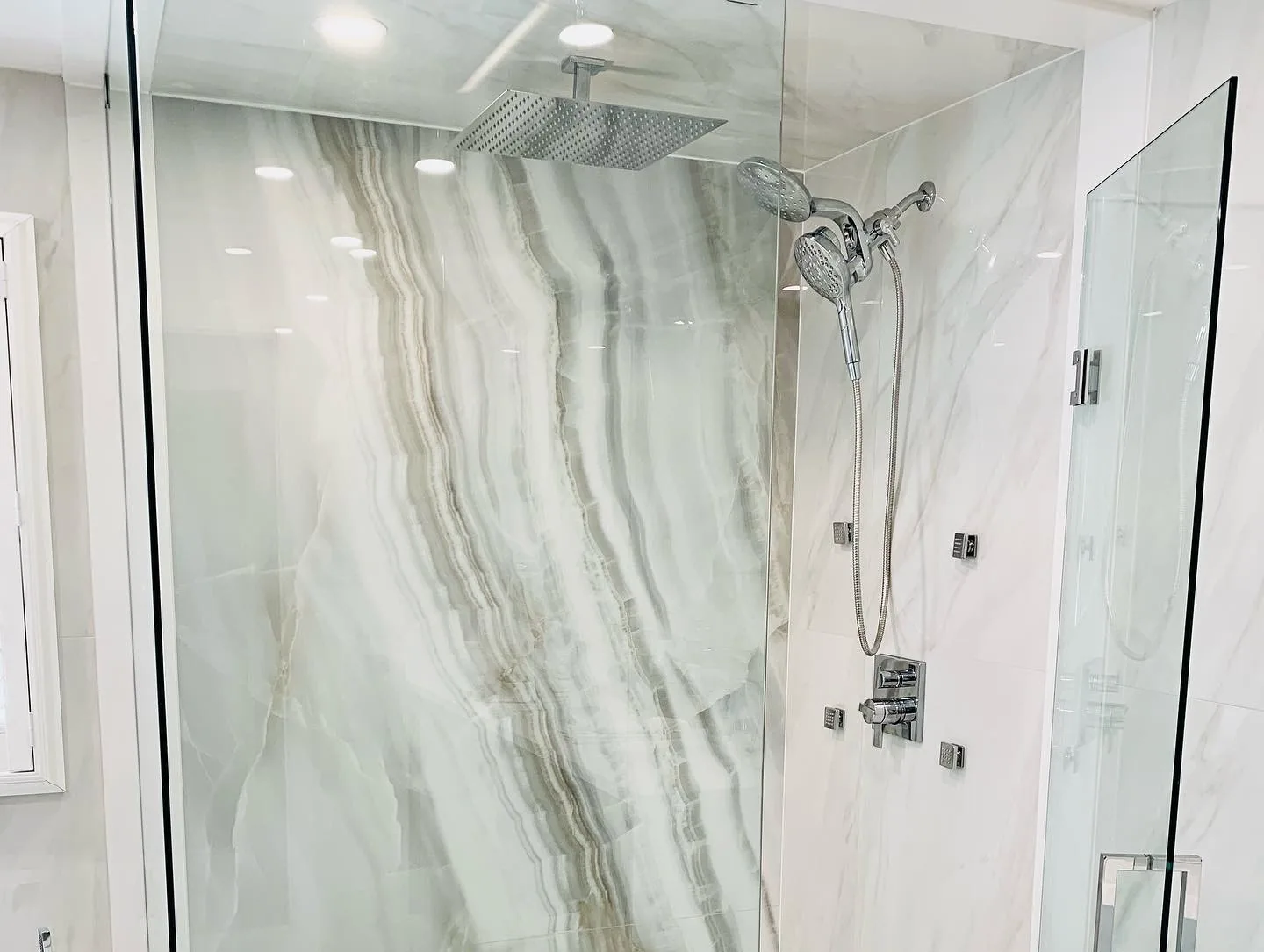
Fewer grout lines is the reason people ask for it. Flatter walls, different handling and a different set of tools are what it takes to deliver – and one of those is not negotiable.
Large-format porcelain (anything roughly 600 × 1200 mm (2 by 4 feet) and up, including the big 1600 × 3200 mm (5 by 10 foot) slabs) looks simple in a showroom. On site it changes the sequence, the preparation and the risk profile of the whole tiling stage.
What the material actually demands
A standard tile can tolerate a wall that is slightly out of plane. The grout joint hides small variations and the thin-set can take up minor differences. A large sheet cannot. Any hollow, any lippage or any deviation greater than a couple of millimetres becomes a visible fault across a single plane. The wall therefore has to be flatter than most renovation walls start out.
That usually means an extra step: checking the substrate with a long straight-edge, grinding high spots, and in many cases applying a levelling compound or a backer board system specifically rated for large format. Skipping this step is the most common reason a big-tile job fails within the first year.
Handling is not optional
A 6 mm thick 1600 × 3200 mm (5 by 10 foot) porcelain sheet weighs enough and is fragile enough that it cannot be moved by one person. It needs two or three pairs of hands, proper suction cups, and a clear path from the truck to the room. In a finished house that path has to be protected; in a tight ensuite the sheet often has to be carried vertically up the stairs and rotated in place.
Tools and technique change
The cutters, the bits and the adhesive are different. Standard wet saws struggle with the longer cuts; bridge saws or large-format cutters are the norm. The adhesive has to be a high-performance, non-slip, deformable thin-set applied with the correct trowel and back-buttering technique so full coverage is achieved. Lippage control systems (clips and wedges) are used almost universally because the eye picks up a 1 mm difference across a 1.5 m joint far more easily than across a 300 mm tile.
Grout joints are fewer, but they still have to be consistent. A 2 mm joint that wanders becomes more noticeable, not less, when the rest of the wall is a single clean plane.
What cannot be fixed later
Hollow spots, lippage and cracked sheets caused by an uneven substrate are permanent. They can be lived with or they can be ripped out; there is no middle option that looks acceptable. That is why the preparation work is written into the quote as a separate line and why we will not start setting large-format material on a wall that has not been checked and corrected.
What to ask at the measure
- Are the walls and floor flat enough for large format, or will levelling be required?
- What is the largest sheet size that can actually be carried into the room?
- Will the sheets be rendered for cutting in AutoCAD before installation?
- What adhesive and lippage system will be used?
- If a sheet is damaged or the batch runs short, what is the realistic replacement time?
Bring the tile name and the nominal size you are considering. We will tell you on the first visit whether the room and the access path can support it, and what extra preparation the quote will need to include. Fewer grout lines are real. The work that makes them possible is also real.